
Imposter Conditioning™ Profile
This page offers interpretation results for completed assessments;
to complete the Imposter Conditioning Profile, click below.
ACTIVATION LEVELS
Each dimension is scored on a 5 to 25 scale. This instrument uses activation level to reflect the strength of a conditioning response, not a judgment about capability.
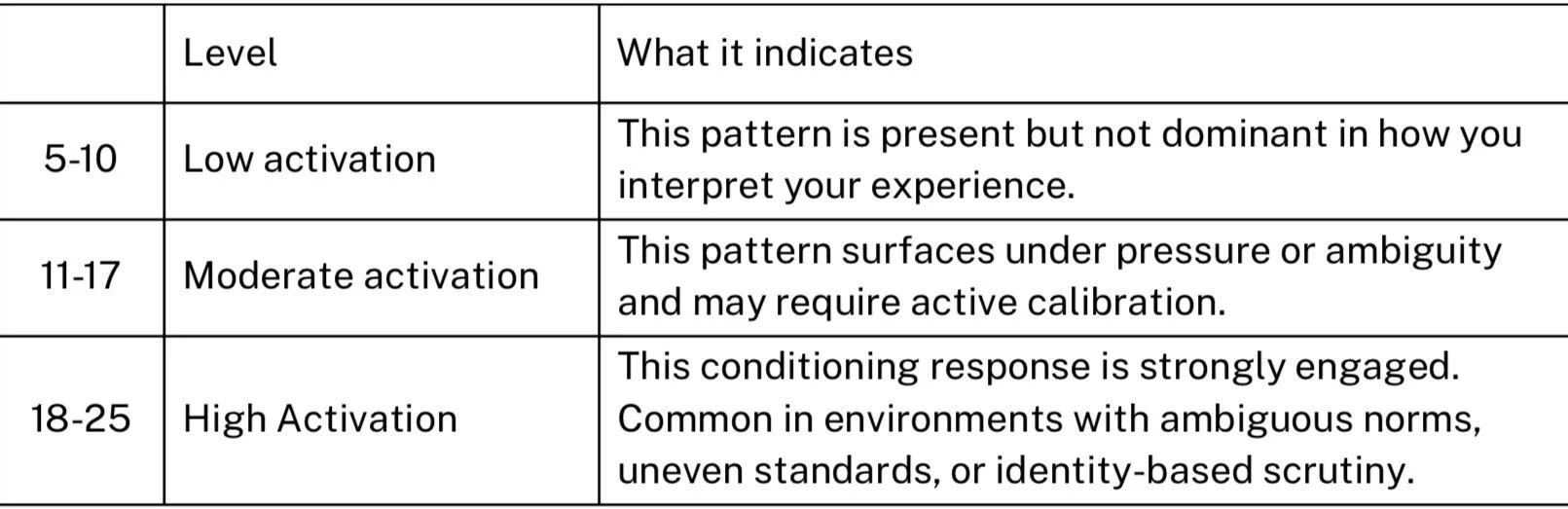
High activation does not indicate weakness. It indicates that a conditioning response is strongly engaged, which is often as a rational adaptation to environments that have historically penalized perceived error, visibility, or assertion.
WHAT THIS ASSESSMENT DOES (AND DOES NOT) MEASURE

The Imposter Conditioning Profile is a tool to identify your learned response patterns in environments shaped by power, expectations, and uneven standards; it has no correlation to: intelligence, competence, readiness for a role, decision, or next step, or leadership potential and your capacity to grow
Patterns surfaced by the assessment are not character flaws. They are the natural and predictable result of navigating systems that were not designed to support your authority as a leader.
PROFILE INTERPRETATION
Your highest-activation dimension(s) identify the pattern(s) most active for you. Combinations reveal specific ways conditioning operates.
Individual Dimensions
-
You might not even notice how quickly your mind moves to “What did I do wrong?” before it considers anything else. It's almost automatic, and it has probably served you well in environments where personal accountability was the expectation and structural critique wasn't available or welcome.
Here's what's worth sitting with: the environment that shaped this reflex may not be the environment you're in now. High Internalization Reflex without the other patterns activated often reflects early conditioning: patterns that were rational responses to earlier circumstances and are now running on outdated data.
This isn't about being harder or softer on yourself. It's about updating your read of the situation. Before the self-critique engages, try pausing long enough to ask:
“What conditions in this environment shaped this outcome?"
-
You've been navigating challenges largely on your own, not necessarily by preference, but because peer networks at this level are thin, the people who might understand the full picture aren’t always accessible, or because visible need has historically come at a cost. As a result, your interpretations have been forming without much external calibration.
Here's what matters most about this pattern: your read might be entirely accurate. Or it might be shaped (even subtly) by the absence of comparative data. Both are worth knowing, and right now you don't have enough outside reference to tell the difference.
The priority here isn't necessarily correcting your perception, but testing it. One honest conversation with the right person can shift years of accumulated, unverified inference. In moments of self-doubt, the question worth asking is:
"Who can reality-test this interpretation with me?"
-
You're picking up on something real. The norms feel inconsistent, the standards seem calibrated for someone else, the environment asks more of you than seems structurally reasonable . . .and you're aware of it. Your read is likely an accurate perception of an ambiguous or uneven environment.
High Personalization Bias without a corresponding Internalization Reflex often means the environment is producing the strain (and you're reading it correctly) but you're translating it into evidence about your individual capacity regardless. The question arising out of your scores is whether what you're experiencing is structurally predictable (something many leaders in similar environments encounter) or a signal about what you can or can't do.
The distinction matters. When experiencing self-doubt, ask yourself:
"What makes this dynamic predictable in this type of environment?"
-
This activation is more targeted than it might feel from the inside. Authority Drift without strong activation in the other dimensions suggests the erosion isn't distributed broadly across your sense of self, it's concentrated. It may be specific relationships, decision contexts, environments, or dynamics that reliably pull you toward doubt, deference, or delay.
This distinction is meaningful, because concentrated patterns are easier to address than generalized ones. The question your scores are pointing toward is less “Who am I as a leader?” and more “What is specifically producing this response, and is it a circumstance I can address, or one I need to make a deliberate decision about navigating?”
The authority is there. The recalibration here starts with small, deliberate choices made without waiting for external confirmation. When self-doubt creeps in, ask yourself:
"What choice can I make right now, without waiting for permission?"
-
The load may be an accurate response to a structurally under-built environment rather than a conditioning distortion. The question is not whether you can carry it — you demonstrably can — but why the carrying is invisible, and what it is costing.
Begin by making the labor visible — to yourself first. Take inventory, without judgment, of the anticipating, smoothing, and carrying you do in a given week that appears on no one’s ledger, including your own. This labor rarely registers as work; it registers as being careful, being professional, being you. Naming it as labor, and locating its origin in the environment’s design rather than your temperament, is the externalizing move. Deciding which of it is genuinely yours to carry comes next.
Inquiry prompt: “What am I carrying to keep this environment steady, and what conditions make that carrying necessary?”
-
Your scores don't point to a single dominant pattern, which is itself worth paying attention to. You're not running one conditioning response across all contexts. Instead, different environments, relationships, and types of pressure activate different patterns. The internalization shows up in some circumstances; the isolation or authority drift, in others.
This kind of context-sensitivity is, in many respects, a resource. It suggests you're reading your environment rather than reacting to it uniformly. The awareness is present.
The work here isn't recalibrating one dominant response. It's developing a more precise map of which conditions tend to activate which patterns in you, so you can make deliberate choices about where you invest your attention and where you restore your authority, rather than having those choices made by circumstance.
When reflecting on your results, a useful place to start:
"Which of these patterns do I recognize most in what I'm navigating right now — and what does that context have in common with others where I've felt this way?"
Common Combinations
-
Something in your environment is unclear: the expectations shift, the feedback is vague, the standards move. The part of you that wants to make sense of your surroundings turns inward. “What did I miss? What should I have done differently?”
The system produces confusion, and you absorb it as evidence about yourself.
This combination is one of the most common patterns among experienced leaders navigating ambiguous or high-scrutiny environments. It isn't a character flaw. It's a learned efficiency: when the environment doesn't offer structural explanations, the fastest available answer is you.
Your scores suggest two things happening at once. One, you're quick to assume the problem is you (Internalization Reflex), and two, you're reading systemic dynamics as personal capacity gaps (Personalization Bias). Together, they create a loop: unclear circumstances produce unexplained discomfort, which your mind routes to self-assessment. You absorb the cost of a system that isn't providing clarity.
When you catch yourself in self-critique, ask:
"What conditions in this environment shaped this outcome?"
-
The Isolation Loop and Authority Drift patterns are connected, and they tend to reinforce each other. The less you share your experience with others for calibration, the more your own judgment becomes the only reference point. When that judgment keeps getting second-guessed, deferred, or overridden, the erosion compounds without any outside signal to interrupt it.
Your scores suggest a pattern of quiet authority erosion sustained by isolation. Not isolation by choice, necessarily — sometimes it's circumstance, sometimes it's the felt cost of being visible, sometimes it's that the right people haven't been accessible. The result is the same: there's no external data correcting the drift.
The work here isn't primarily internal. It requires input from outside yourself, specifically, calibrated dialogue with others who can reality-test your interpretations and reflect your authority back to you. That's not an indulgence, it's structurally necessary for growth. Ask yourself:
"Who can reality-test this interpretation with me?"
One note worth naming: this pattern often doesn't feel like drift or isolation from the inside. It can feel like independence, like not being a burden, like handling things. That perception isn't wrong, but it can obscure what the pattern is costing you. Recalibration starts by recognizing that, and choosing one person with whom to close the loop.
-
These two patterns form a closed loop, and that's what makes them worth examining together.
When Internalization Reflex is high, the mind moves quickly to self-explanation: What did I do wrong? What did I miss? What does this say about me? It's a fast, familiar pattern, and one that often developed because personal accountability was the expected response to uncertainty, and structural explanations weren't available or welcome.
When Isolation Loop is also high, those interpretations form without much external input to test them. Not necessarily by design, but because the people who might calibrate your read haven't been accessible, because visibility has carried a cost, or because the weight of what you're navigating doesn't translate easily into a conversation you'd want to have.
The result is a self-sealing pattern. You move quickly to a verdict about yourself, and then you carry that verdict largely alone. Because the interpretation never gets tested, it doesn't get corrected. What starts as a provisional read can solidify, over time, into something that feels like fact.
What matters most here isn't whether your self-assessment is right or wrong. It's that you may not yet have enough information to know. The internalization feels accurate precisely because it hasn't been contradicted, and it hasn't been contradicted because the conditions for that haven't been in place.
The question worth sitting with:
"If someone I respected described this situation to me, would I give them the same read I've been giving myself?"
-
There is a unique kind of tired that comes from work no one sees you doing: anticipating, smoothing, absorbing of tension before it surfaces. This work keeps the environment functional, but it doesn’t appear on anyone's ledger, often including your own.
When Isolation Loop is also high, a second layer forms – the carrying itself goes unwitnessed. You don't bring it to peers, partly because it doesn't register as work worth naming. It registers as being careful, being professional, being you. When others appear to navigate similar environments without strain, the comparison subtly confirms that the weight must be personal.
These two patterns conceal each other. The load stays invisible because you don't speak it; you don't speak it because the load stays invisible. What can't be seen can't be counted, shared, or renegotiated.
Your scores suggest labor carried without witness. The first move isn't to put the load down – some of it may be a rational response to an environment that is genuinely under-built. Instead, the first move is to have it seen, by yourself and by at least one person who can confirm that what you're carrying is real, common, and produced by conditions rather than temperament.
The question worth sitting with:
"Has anyone actually seen what it takes to keep this steady, and if not, what would change if someone did?"One note worth naming: from the inside, this pattern reads as competence (e.g., quiet reliability, needing nothing). The competence is real, but what it obscures is the cost.
-
High Load Absorption + High Authority Drift
On paper, these look like separate patterns, one about unseen labor and another about eroding judgment. In practice, they draw from the same account. The anticipating, calibrating, and tension-absorbing that keep an environment steady consume exactly the resources that clear decisions require.
Your scores suggest authority eroding not through self-doubt, but through depletion. When most of your capacity goes to managing how things land, less remains for deciding what things should be. Decisions wait for external validation, not necessarily because you distrust your judgment, but because validation is one more way to keep the environment steady. Overriding your own read to preserve harmony isn't a separate failure of nerve; it's the load absorbing your authority in real time.
Notice the tradeoff this pattern quietly enforces. Every decision becomes two jobs: 1) making it, and 2) cushioning it. When the cushioning feels mandatory, the deciding narrows to what can be cushioned. Over time, that narrowing can be mistaken for lost confidence, when what's actually lost is capacity.
The recalibration here isn't to push harder on decisiveness. It's to notice where steadiness-keeping is spending your judgment before you get to use it and to reclaim one decision at a time from the cushioning requirement.
Ask yourself:
"If I weren't managing how this lands, what would I decide?"

Naming the pattern doesn't change your circumstances.
But it changes your relationship to them, which is where your authority begins to shift and your capacity grows.
If this Instrument Surfaced Something Meaningful for You
The Imposter Conditioning™ Profile is the beginning of a conversation, not a conclusion. The patterns it identifies are common among experienced high-performing women leaders – not because something is wrong with them, but because the environments they navigate are designed to produce these responses.
Naming the issue is the starting point. The work of externalizing, interpreting, differentiating, and restoring happens in relationship: with peers who are navigating the same terrain, and with the structure to do it rigorously.